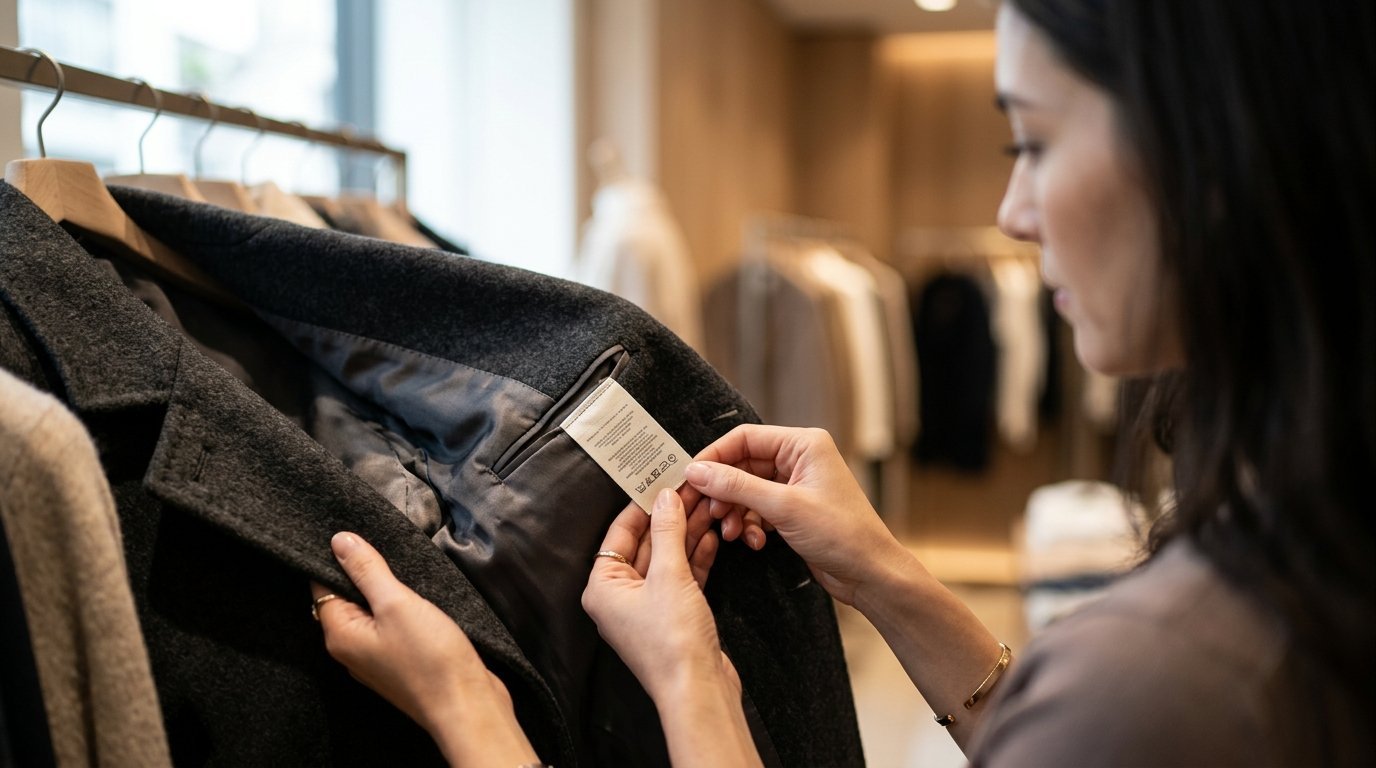
Every garment carries a label that answers most of the questions people ask after they get home: will this shrink, will it need ironing, will it still look like this in a year. It takes about twenty seconds to read, and almost nobody does.
Fibre content is the important line
The percentages are listed heaviest first. That ordering matters more than the individual numbers, because the dominant fibre determines how the garment behaves.
- Cotton breathes well, softens with washing and takes dye nicely. It creases, and untreated cotton can shrink on a first hot wash.
- Wool insulates even when damp, resists odour and holds its shape. It needs gentle washing and can felt if agitated in heat. Merino is finer and less itchy than standard wool.
- Linen is exceptionally breathable and gets better with age. It creases enthusiastically, which is either the charm or the problem depending on your temperament.
- Polyester resists creasing, dries fast and holds colour. It traps heat and odour more than natural fibres.
- Nylon is strong and abrasion-resistant, which is why it shows up in outerwear and in small amounts in knitwear for durability.
- Elastane (also sold as spandex or Lycra) provides stretch and recovery. Two to five per cent is usually enough; more than that and the garment may lose its shape over time.
- Viscose and rayon drape beautifully and feel cool, but they weaken when wet and can shrink noticeably.
Reading blends honestly
A blend is a compromise, and the ratio tells you which direction the compromise went. A jumper at 80% wool and 20% nylon is a wool jumper with added durability. A jumper at 20% wool and 80% acrylic is an acrylic jumper being marketed on the word wool.
Neither is wrong to buy — acrylic knitwear is cheap, washable and warm — but you should know which one you are paying for. If the price sits close to a mostly-natural garment while the label says otherwise, that is worth noticing.
Care symbols in plain terms
The symbols are standardised, and the five shapes cover almost everything you need:
- The tub is washing. A number inside is the maximum temperature in Celsius. A hand means hand wash only. A cross through it means do not wash.
- The triangle is bleaching. Crossed out means no bleach.
- The square is drying. A circle inside means tumble dryer; dots indicate heat level. A crossed-out square with a circle means no tumble drying.
- The iron is ironing, and the dots are temperature — one dot is cool, three is hot.
- The circle is professional cleaning. A letter inside is instruction for the cleaner, not for you.
The practical question is whether the care instructions fit your actual routine. "Dry clean only" on a shirt you would wear weekly is a recurring cost, and most people quietly stop wearing those garments rather than keep paying it.
What the label does not tell you
Fibre content says nothing about how well the garment is made. For that, turn it inside out:
- Seams should be straight and the edges finished, not raw and fraying.
- Stripes and patterns should line up where two panels meet. Mismatched patterns mean the maker was economising on fabric.
- Give a seam a gentle pull. You should not see the stitching gap open.
- Buttons should be firmly attached, ideally with a spare sewn inside. Buttonholes should be neatly finished with no loose threads.
- Zips should run smoothly through their whole travel. A sticky zip in the shop will not improve.
- Check the fabric weight by holding it up to the light. If a t-shirt or shirt is noticeably see-through when you did not expect it to be, that is thin fabric and it will wear through sooner.
Country of origin
This tells you less than people assume. Quality varies enormously within every manufacturing country, and the same factory often produces for several price tiers. Treat it as information rather than a verdict — construction quality, which you can see with your own hands, is the more reliable signal.
Making it a habit
None of this requires expertise. Check the fibre content, check the care symbols against your real laundry habits, then turn the garment inside out and look at two seams. It costs half a minute and it filters out most of the purchases people later regret.