Footwear is one of the few clothing categories where price and lifespan are genuinely linked — but only in some categories, and only up to a point. The deciding factor is usually how the shoe is put together, not the name on the side.
How the sole is attached decides almost everything
There are three common methods, and they determine whether a shoe can ever be repaired.
Cemented construction glues the upper to the sole. It is cheap, light and flexible, and it covers the overwhelming majority of shoes sold. When the sole wears through or separates, the shoe is generally finished — a cobbler can sometimes re-glue it, but it is a patch rather than a repair.
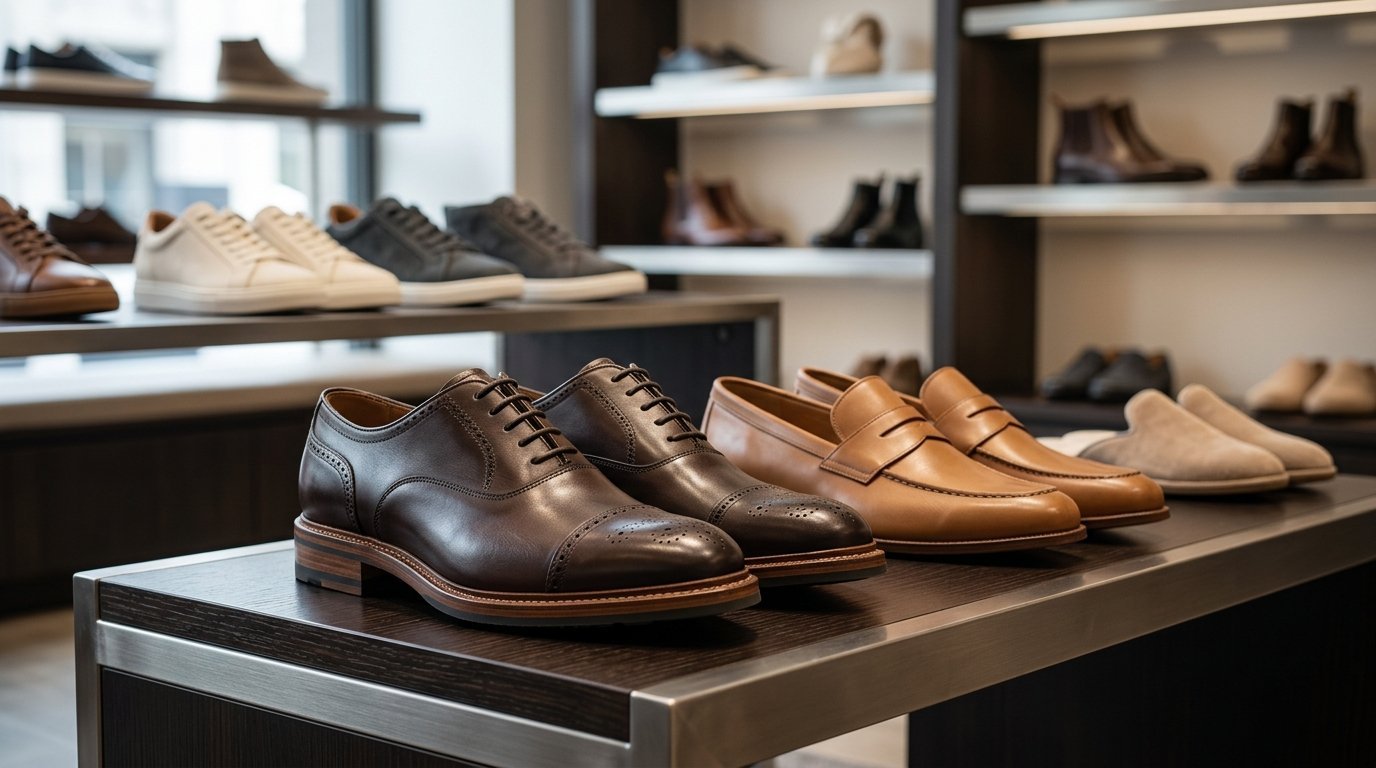
Goodyear welted construction stitches the upper to a leather welt, which is then stitched to the sole. It is heavier, stiffer at first, and considerably more expensive. In exchange, the sole can be replaced several times by any competent cobbler, and the shoe can last many years.
Blake stitched construction stitches the upper directly to the sole. It is sleeker and more flexible than a welt, and still resoleable, though it needs a cobbler with the right machine.
You can often identify a welt by looking at the edge of the sole for a line of stitching running around the perimeter. If you intend to keep a pair of formal or work shoes for years, this is the single most important thing to check.
Leather quality, briefly
"Genuine leather" sounds reassuring and is actually a low grade — it refers to the layers left after the best part has been split off. Full-grain leather keeps the outer surface intact and is the most durable; it develops a patina rather than wearing out. Top-grain has been sanded to remove blemishes, which looks more uniform and costs less but is slightly less hardwearing.
Bonded leather is scraps reconstituted with adhesive and behaves more like heavy cardboard over time. If a shoe is described only as "man-made materials" or "leather-look", price it as a synthetic shoe, which may be entirely fine for the use you have in mind.
Where paying more genuinely returns the money
- Formal and office shoes worn several times a week. A welted pair that is resoled twice can outlast four or five cemented pairs, and it will look better throughout.
- Walking and hiking boots. Fit, ankle support, sole grip and waterproofing all improve with price up to the mid range, and blisters on day two of a walking holiday are a genuine cost.
- Work boots with safety requirements. Certification and protection are not places to economise.
- Anything you wear daily. Cost per wear does the arithmetic for you.
Where it usually does not
- Fashion-led styles. If you are buying for a look that will feel dated in two years, durability is not the constraint.
- Occasional-wear shoes. A pair worn four times a year will not wear out regardless of construction.
- Children's shoes. Fit and outgrowing dominate. Buy properly fitted, not expensive.
- Beyond a certain point in any category. Above the mid-to-upper range, a great deal of the price is design, brand and finishing rather than function.
Running shoes are their own case
Running shoes are consumable. The midsole foam compresses with use and loses its cushioning long before the upper looks worn, so replacement is driven by mileage rather than appearance. Paying more buys you better materials and fit, not indefinite life.
This is one category where buying last year's model at a discount makes obvious sense — the changes between annual revisions are frequently small, and the previous version is often heavily reduced when the new one lands.
Fit beats everything above it
An expensive shoe in the wrong shape is worse than a cheap one in the right shape. Feet swell during the day, so try shoes on in the afternoon, wear the socks you will actually use, and stand up and walk. There should be roughly a thumb's width in front of the longest toe, and the widest part of your foot should sit at the widest part of the shoe.
Good leather shoes soften and mould slightly to your foot, but they do not change size. If a shoe pinches in the shop, it will pinch at home.
Getting more out of what you own
Rotating between two pairs rather than wearing one daily lets the lining dry out fully and meaningfully extends the life of both. Shoe trees keep leather from creasing permanently. Cleaning and conditioning leather a few times a year takes minutes. And getting a worn sole replaced before it wears through to the upper is what makes a resoleable shoe worth having in the first place.