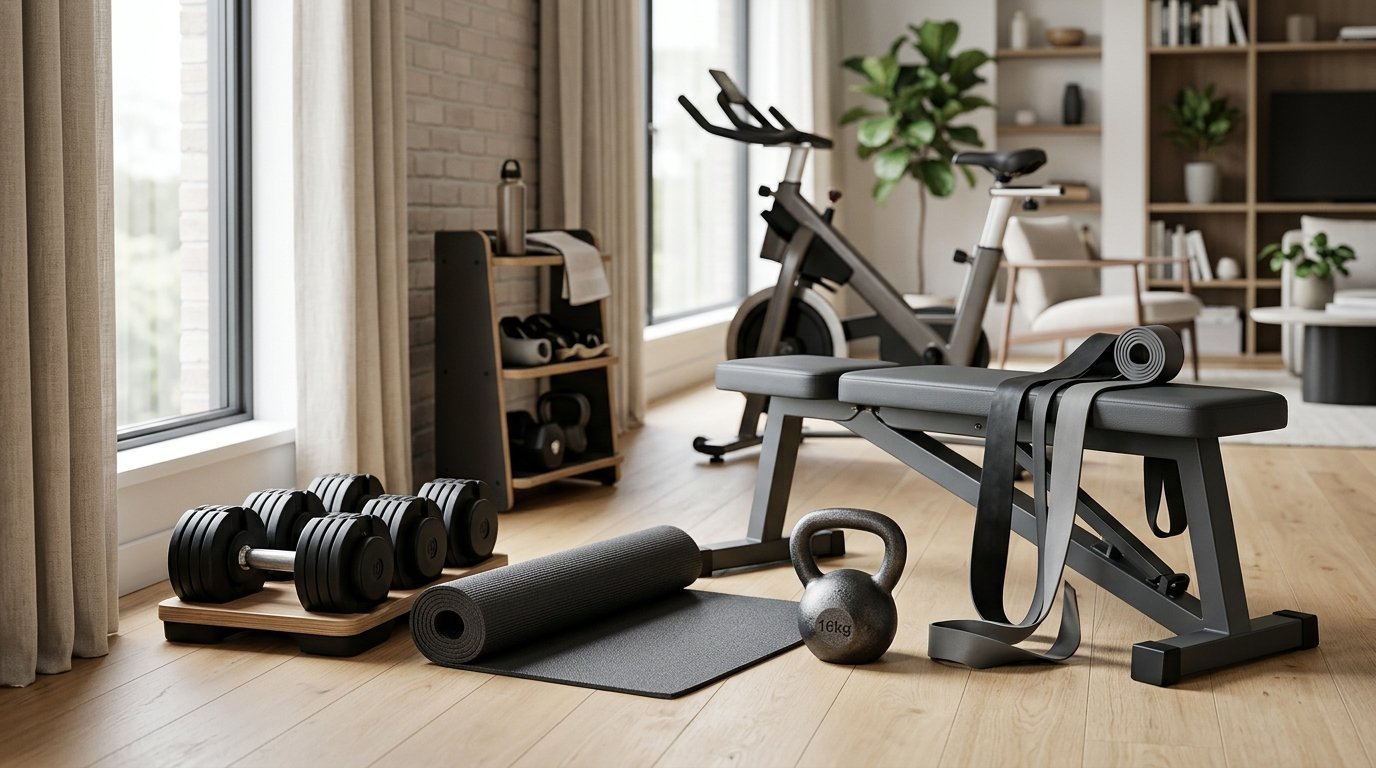
Home fitness equipment has a well-earned reputation for becoming furniture. The pattern is familiar: a large machine arrives, gets used enthusiastically for a few weeks, and then occupies a corner indefinitely. Buying in a different order avoids most of that.
A quick note before the list: if you are returning to exercise after a long gap, are pregnant, or have an injury or a health condition, get advice from a doctor or a qualified trainer about what is appropriate for you. This article is about equipment, not programming.
The order that tends to work
Buy versatile, compact and cheap first. Buy large and specialised last, once you know you will use it.
1. A mat
Unglamorous and genuinely the first thing worth owning. It makes floor work possible on a hard surface, protects the floor, and marks out a space that signals you are exercising. Thicker mats suit floor exercises; thinner, grippier ones suit anything where balance matters.
2. Resistance bands
A set of loop or tube bands costs very little, stores in a drawer and covers a wide range of movements for the whole body. They are also the most practical way to add resistance to rehabilitation and mobility work, and they travel.
Buy a set with a range of tensions rather than a single band. The cheapest sets tend to snap or lose elasticity, so the very bottom of the market is a false economy, but you do not need to spend much.
3. Adjustable dumbbells or a few fixed pairs
This is the first significant purchase and the one that delivers the most. Adjustable dumbbells save enormous space compared with a rack and cost less than buying many fixed pairs, though the dial-and-selector mechanisms add cost and can be less robust than plain iron.
Fixed dumbbells are cheaper per kilogram, effectively indestructible, and easy to buy second-hand. If you have the floor space and you know roughly what weights you need, they are hard to beat on value.
4. A bench or a stable equivalent
An adjustable bench opens up a large number of dumbbell exercises. It is bulky, so consider it once you are confident the dumbbells are getting used. A sturdy step or a firm chair covers some of the same ground in the meantime.
5. A pull-up bar
Cheap, small, and one of the most useful upper-body tools there is. Doorway bars that brace against the frame require a suitable doorway and a check that the frame can take the load — read the fitting instructions properly, because this is one of the few items here that can fail badly.
The large machines
Treadmills, rowers, exercise bikes and elliptical trainers are where most of the money and most of the regret goes. They are worth buying when you already know you will use that specific activity — you have been running, rowing or cycling regularly and want to do it at home.
Buying one to start a habit is the expensive version. If cardio equipment is the goal, consider that a folding bike trainer or a decent pair of running shoes gets you moving for a fraction of the cost while you find out whether the habit sticks.
When you do buy, the practical questions are: what is the footprint when it is set up, does it genuinely fold, how heavy is it to move, how loud is it for anyone else in the building, and what is the warranty on the motor or the frame.
Buying second-hand
Weights are the ideal second-hand purchase. Cast iron does not degrade, there is no electronics to fail, and it is heavy enough that sellers price it to be taken away. Check for rust and cracks, and confirm the plates fit standard or Olympic bars as needed.
Large cardio machines are riskier used. Motors, belts, consoles and resistance mechanisms all wear, spare parts may be unavailable, and moving one is a serious job. If you do buy used, insist on seeing it working at several settings before money changes hands.
Space and storage decide what gets used
Equipment that has to be assembled, moved or dug out from under something else gets used less. Whatever you buy, have a plan for where it lives when it is not in use — and if the answer is "in the middle of the living room", that is important information about whether you will keep it.
A reasonable starting kit
A mat, a set of bands, one pair of dumbbells at a weight you can currently use and one heavier pair to grow into. That covers a great deal of training, costs a fraction of a single machine, and stores in a cupboard. Everything after that is easier to judge once you know how you actually train.